TL;DR
Business owners and those building conversational AI assistants hold the crucial role in turning generic bots into revenue drivers. At Invent, we see founders personally mapping conversation flows, training on Zoho/WhatsApp data, and setting human-AI boundaries, driving 40% faster resolutions. This hands-on role isn't optional; it's how conversational AI scales for SMBs. Here's your playbook.
The human–AI conversational role is the discipline of translating your brand's voice, values, and personality into how your AI behaves, so every customer feels like they're talking to the brand, not a bot.
That means observing how your best people communicate. Encoding that into interaction patterns. Designing for trust and transparency. And knowing exactly when to hand a conversation to a human.
At useinvent.com, we're building the platform where this work happens naturally, so you don't need to be an AI engineer to give your AI a soul.
The future is conversational. Make sure it sounds like you.
Introduction
We've spent years designing beautiful interfaces. Screens. Flows. Buttons that convert. And we got very good at it. But the next frontier is a conversation.
For most businesses, this shift is happening faster than they're ready for. AI is being deployed across customer service, sales, onboarding, support, and in most cases, it sounds exactly the same. Generic. Helpful but hollow. Indistinguishable from every other brand doing the same thing. This is's a design problem.
Why Business Owners own conversational AI success
Founders define the conversational AI strategy: What does "win" look (CSAT>90%, 20% lead conversion)? They supply proprietary data (past lessons, sales scripts) that generic LLMs lack. Without this, assistants stay surface-level.
The Builder's hands-on role
- Flow Design: Owners sketch 80% of paths (FAQ→upsell→handoff), Invent auto-fills the rest.
- Training: Upload CSVs for 95% accuracy on your jargon/deals—your edge over competitors.
- Testing: Weekly live chats to catch edge cases; retrain weekly.
What customers actually want from AI
Your customers don't want to talk to a chatbot.
They want to talk to you, your brand, your way of explaining things, your warmth or your precision or your dry sense of humor. The AI is just the channel.
This is the distinction most businesses miss when they deploy conversational AI. They configure a model, write a few system prompts, and assume the work is done. But the customers on the other end still feel it: something is off. The responses are correct but they're not right. There's no soul in the exchange.
What's missing is intentional design, the same care that goes into a brand identity, a product experience, a customer journey, applied to how the AI talks.
"No matter who is behind the conversation, your customer should feel they are talking to the brand."
That's the promise of the human–AI conversational role. And it's the problem we're building useinvent.com to solve.
Defining the human–AI conversational role
The human–AI conversational role is not a job title. It's a discipline, a new area of expertise that sits at the intersection of brand strategy, experience design, and AI behavior.
It asks a fundamentally different question than most AI implementations start with:
Not "what can the AI do?", but "what should it feel like to talk to our brand?"
People who work in this role are responsible for:
- Translating brand identity into AI behavior. This goes beyond a tone-of-voice guide. It means defining the vocabulary the AI uses, the words it never says, how it handles an emotional customer, how it delivers bad news, how it expresses uncertainty, and doing this consistently across every touchpoint.
- Defining end-to-end human–AI journeys. Every conversation has a shape: it starts somewhere, it has friction points, it reaches a resolution or it doesn't. Mapping these journeys, across client experiences, advisor workflows, support interactions, reveals where AI adds value and where it creates risk.
- Shaping interaction patterns. How does the AI ask clarifying questions without feeling intrusive? How does it make a recommendation without being pushy? How does it explain a complex topic without being condescending? These patterns need to be designed, not left to chance.
- Embedding responsible AI principles. Fairness, transparency, and safety are not legal requirements to be checked off. They are experience design decisions. In high-stakes conversations, finance, healthcare, legal, customers need to understand what the AI knows, what it doesn't, and who is accountable. That has to be built into the interaction itself, not disclosed somewhere in the fine print.
- Designing for escalation. The best conversational is the one that knows when a human should take over, and makes that handoff feel seamless, not like a failure. Escalation design is one of the most underinvested areas in AI experience, and one of the most consequential.
Why this is harder than it looks
Most organizations treat conversational AI as a feature deployment. They pick a model, configure some guardrails, and ship.
What they're actually doing is creating a new brand representative, one that will speak to thousands or millions of customers, at any hour, across any channel, without a manager watching.
That representative needs to be designed with the same rigor as any other brand asset.
Here's what that rigor looks like in practice:
1. Observation before automation
Before you can give an AI your brand's voice, you need to deeply understand what that voice is, not from a brand guidelines document, but from watching real conversations. How do your best people actually talk to customers? What words do they use? How do they handle a frustrated customer at the end of a long day? How do they explain something complicated to someone who's hearing it for the first time?
That observational work, almost ethnographic in nature, is the foundation of everything else.
2. Voice translation, not voice imitation
There's a critical difference between an AI that imitates a human voice and one that embodies a brand voice. Imitation breaks under pressure, when the conversation goes somewhere unexpected, the mask slips. Embodiment is structural: the brand's values are encoded into how the AI reasons and responds, not just how it phrases things.
This is the work of building an AI persona: defining not just how it talks, but how it thinks about problems, what it prioritizes, where it draws its own lines.
3. Trust as an interaction design problem
Trust is not given, it's earned through repeated, consistent, honest exchanges. In conversational AI, that means designing for transparency at every step: acknowledging uncertainty, explaining reasoning, making limitations visible, and never overpromising what the AI can do.
Research consistently shows that users extend more trust to AI systems that are honest about what they don't know than to systems that project false confidence. Designing for trust is about making it more honest.
4. The escalation design gap
One of the most neglected aspects of conversational AI experience is the moment when the AI reaches its limit, and needs to hand the conversation to a human.
This transition, if handled poorly, destroys the entire experience. It feels like abandonment. It signals that the AI was the wrong choice from the start.
If handled well, it's invisible. The customer doesn't feel passed off. They feel taken care of. That requires designing the handoff as carefully as any other step in the journey: what triggers it, how it's communicated, what context is carried forward, and how the human picks up without making the customer repeat themselves.
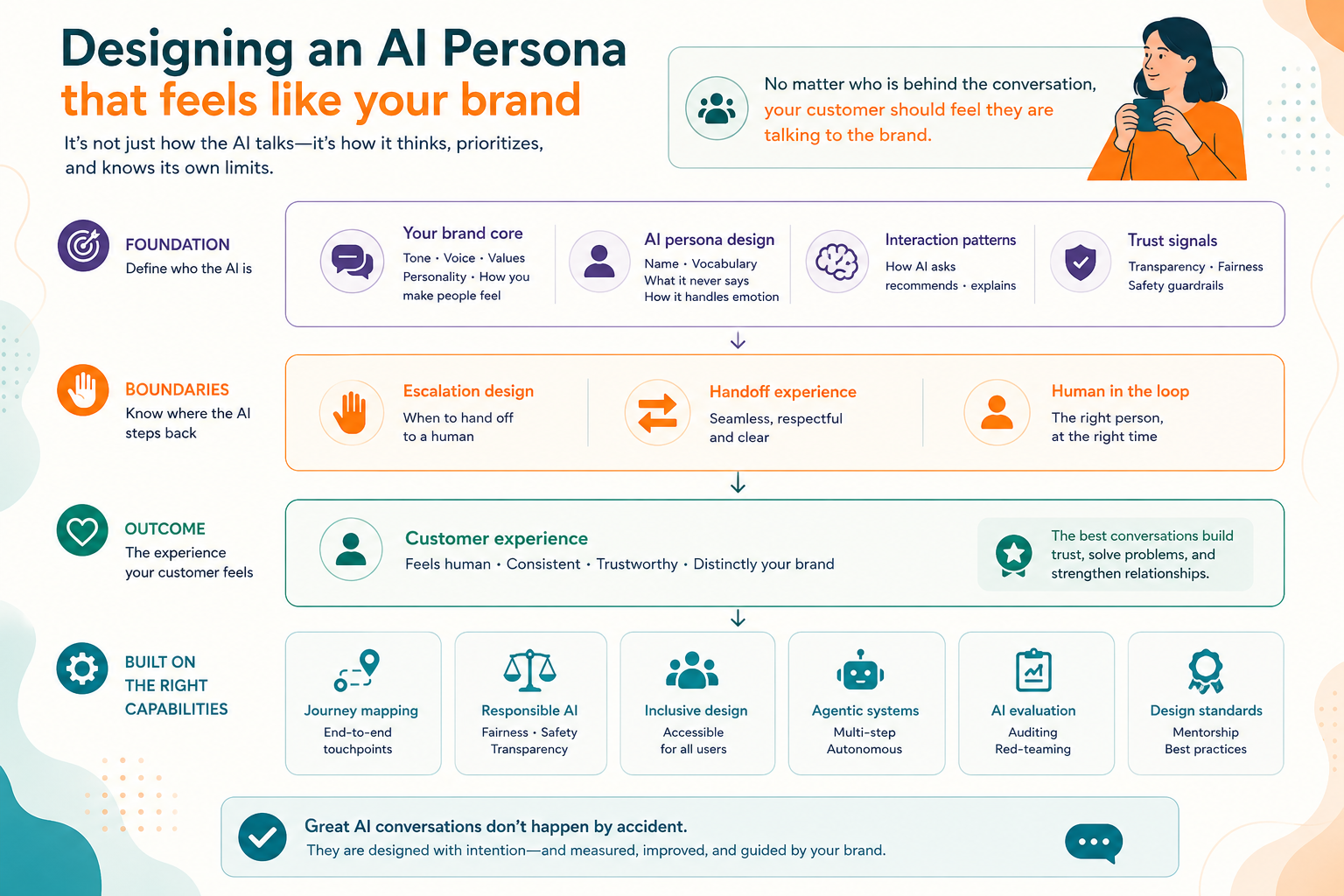
Design AI personas that embody your brand, combine the right tone, trust signals, escalation flows, and inclusive design to create conversations that feel human, build trust, and reflect your unique identity.
The skills this discipline requires
The human–AI conversational role draws on a specific combination of expertise that doesn't map neatly to any existing job category.
It requires:
- Experience design, the ability to map journeys, identify friction, design for edge cases, and prototype interactions before they're built.
- AI literacy, understanding how language models behave, where they fail, how prompting and context shape output, and what "agentic" systems mean for workflow design.
- Research and validation, running user studies, testing for comprehension and trust, identifying where the AI loses people, and iterating based on evidence rather than intuition.
- Responsible AI practice, understanding fairness, bias, and safety not as abstract principles but as design constraints that shape decisions at every level.
- Inclusive design, ensuring that conversational experiences work for users with different abilities, languages, literacy levels, and cultural contexts. A voice that works for one demographic can alienate another.
- Service design, seeing the full system, not just the conversation. Understanding how AI fits into existing workflows, how it changes staff roles, and how it creates new kinds of organizational accountability.
This combination is rare. It's one of the reasons the demand for people who can do this work, and do it well is significantly outpacing supply.
What we're building at useinvent.com
At useinvent.com, we're building the platform where this work happens naturally.
Our belief is simple: you shouldn't need to be an AI engineer to give your AI a soul.
Business owners, brand teams, experience designers, and customer success leaders should be able to step into the human–AI conversational role without writing a line of code. They should have tools that help them observe, feel, and understand their own brand voice, and then translate it into AI behavior that their customers will recognize instantly.
We're building for:
- The business owner who wants their AI to sound like them, not like every other business using the same model.
- The experience designer who understands conversation as a medium and wants the tools to design it properly.
- The brand team that has spent years building a voice and doesn't want AI to erase it.
- The cross-functional team, product, engineering, research, that needs shared standards and a shared language for how AI should behave.
What we're creating is not a chatbot builder. It's a conversational design platform, a place where brand voice, interaction patterns, trust signals, and escalation logic can be defined, tested, and scaled.
The future is conversational, and it must feel like you
Every major shift in how humans interact with technology has eventually become invisible. The interface disappears; only the experience remains.
Conversation is the most natural human interface that exists. It requires no onboarding, no manual, no learning curve. When AI gets conversational design right, it doesn't feel like technology at all. It feels like talking to someone who understands you.
The brands that invest in this now, that take the human–AI conversational role seriously, that design their AI's behavior with the same care they design their products, will have a significant advantage. In the thing that matters most in any business relationship: trust.
The future isn't just conversational. It's yours to design.
FAQs
What is the human–AI conversational role?
The human–AI conversational role is a discipline that combines brand strategy, experience design, and AI behavior design. It focuses on translating a brand's voice, values, and personality into how an AI system communicates, so customers feel they are talking to the brand, not a generic AI assistant.
How do you translate brand voice into an AI persona?
Brand voice translation starts with deep observation of how real people in your organization communicate with customers. From there, it involves defining vocabulary, tone, escalation logic, and behavioral constraints that are encoded into the AI's configuration, reasoning and decision-making.
What is responsible AI in the context of conversational design?
Responsible AI in conversational design means embedding fairness, transparency, and safety into user-facing interactions. This includes being clear about what the AI knows and doesn't know, designing for diverse users and contexts, and creating honest escalation paths when the AI reaches its limits.
What is agentic AI and why does it matter for conversational design?
Agentic AI refers to AI systems that can take multi-step actions autonomously, execute tasks, make decisions, and interact with other systems. Conversational design for agentic AI requires careful attention to how intent is understood, how actions are confirmed, and how errors are surfaced and corrected.
What does useinvent.com do?
Invent is building a platform for human–AI conversational design, tools that allow business owners, designers, and teams to define, test, and scale their brand's conversational AI experience without requiring deep technical expertise.
What role do business owners play in conversational AI?
They define strategy, supply data, design flows, and iterate, turning assistants into proprietary assets.
How does Invent empower assistant builders?
No-code tools + proprietary training for SMBs to own their conversational AI edge.